

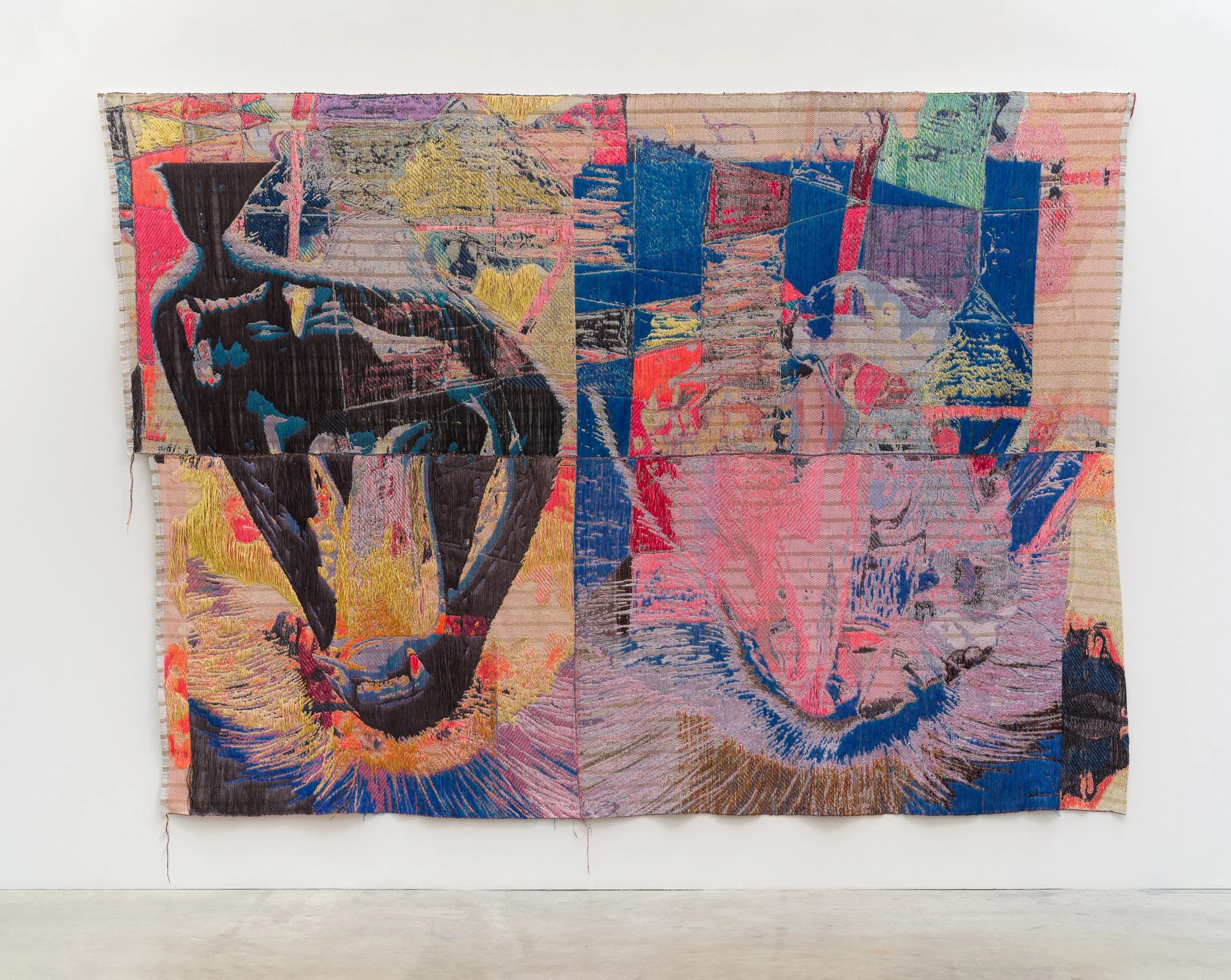
Moving between drawing, aerial imagery, computational processes and woven structure, I repeatedly translate images from one system into another, allowing distortion, material resistance and error to become generative.

digital wovens
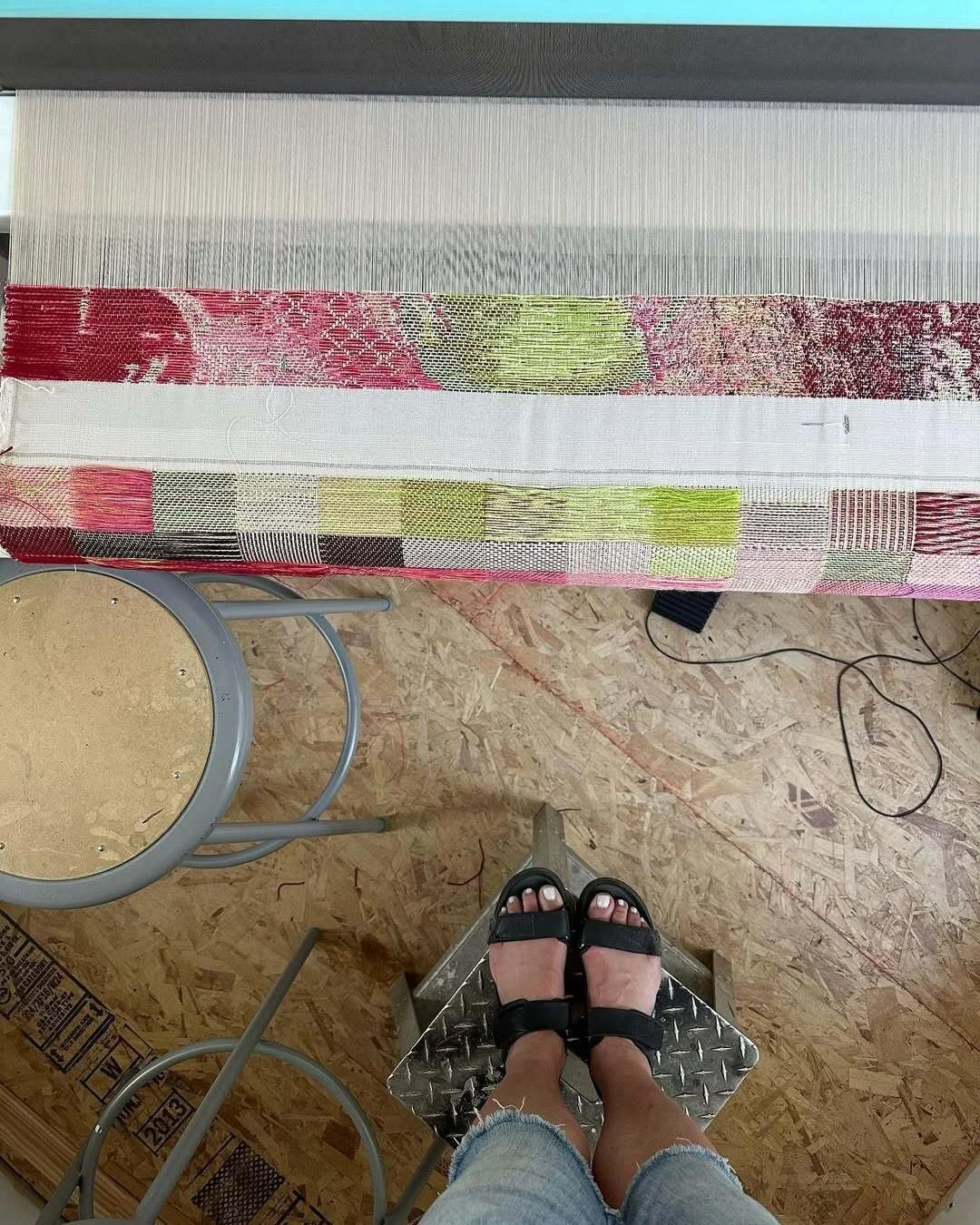
Working on the TC2 digital Jacquard loom, I translate images into computational weave structures that determine how thousands of individual warp threads rise and fall. Yet the weaving remains physical and embodied: I throw each shuttle by hand, responding to the cloth as it emerges.

frame loom wovens
On the frame loom, that relationship is reversed. There is no code or automated selection; every shape is built manually through discontinuous weft, tension, gesture, and touch.
These two weaving systems are separated by centuries, yet both operate through the same fundamental logic - warp and weft, over and under, structure and pattern. Moving between them reveals the loom not as an ancient technology opposed to computation, but as part of a long continuum of systems for encoding, translating, and materializing information.
artist statement
My work investigates how landscape is translated, monitored, and reconstructed through technological systems, moving images through drawing, digital processes, and woven structure. I work with aerial imagery, surveillance, environmental data, and photographs of changing landscapes, treating them not as fixed representations but as unstable information—images continually altered through acts of seeing, recording, and translation.
My research draws on Daisyworld, James Lovelock and Andrew Watson’s speculative model of planetary self-regulation, alongside water systems, ecological feedback loops, and environmental instability. These systems inform how I construct speculative landscapes: layered fields in which geological forms, digital artifacts, glitches, and fragments of environmental imagery collide. Landscape becomes less a view than a dynamic system—something sensing, adapting, degrading, and reorganizing under pressure.
Images move recursively between hand drawing, digital manipulation, and the coded structures of the loom. With each translation, information is lost, distorted, or unexpectedly generated. I am interested in this degradation as a form of knowledge: the glitch becomes evidence of transformation.
By bringing tapestry into conversation with computational image culture, I use weaving as both material practice and information system—a structure through which landscape can be encoded, disrupted, and imagined otherwise.
Weaving becomes meaning and metaphor for contemplating memory, erosion, impermanence, continuity, and our place within deep time.
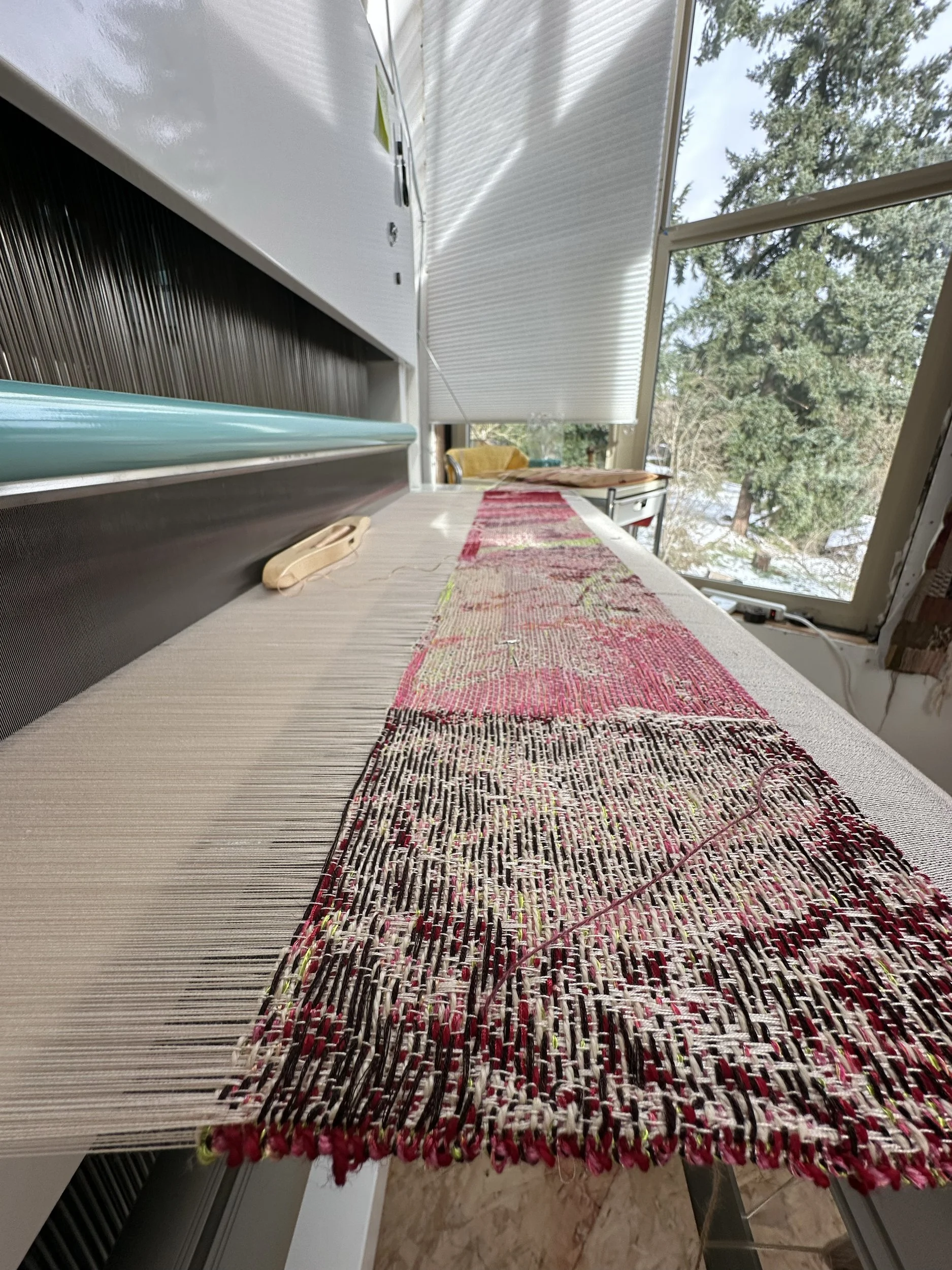
the process of digital handweaving
Socolofsky’s work combines the skill and sensitivity of painting with the structured complexity of ancient frame and industrial Jacquard weaving to produce woven tapestries that hover just on the edge of recognition. Her process begins by layering drawings with sourced consumable images: moving drone stills, google earth snapshots, photographs of everyday objects, transforming them using mathematical strategies; then translating these designs into instructions the looms can interpret.
All work is hand woven - combining ancient handwork with computational crafting